Guest Blogger: Kate Powers Does Theatre Up the River

Document4A couple of weeks ago, my sister-in-law, Dawn, blogged about her theater work in prisons.  So when I found out that my fellow director, Kate Powers, is still actively directing at Sing Sing (and knows Dawn), I asked her to please share her experiences with us.  My limited knowledge of prison theater consists of Beckett’s production of Waiting for Godot at  Lüttringhausen Prison as well as that amazing season of Oz with Betty Buckley. Kate is not only creating art but being of service.  Theatre is an amazing outlet for those who want to grow.

So without further ado…

“Theatre inspires me.”

“Theatre teaches me about myself, and helps me to understand why other people do what they do.”

“Theatre relaxes me.”

“Theatre teaches me empathy.”

“Everyone in my life was a backstabber or a deceiver.  I never knew what trust was until I started making theatre.”

I didn’t say any of these things; actors in my latest project did.  Many directors learn from their collaborators or are moved to think differently because of an encounter with a particularly gifted, or especially irksome, actor.  The individuals in this production rock my world regularly and have revealed many of our received ideas to be built upon ignorance, fear, salaciousness and indifference, but not on reality.  I work as a director, teacher and facilitator for Rehabilitation Through the Arts, or RTA (www.rta-arts.org).  I work with men who are incarcerated at Sing Sing Correctional Facility, a maximum security prison north of New York City.  Sing Sing gave us the phrase ‘the big house’ and it is the origin of the euphemism ‘up the river.’

RTA was founded at Sing Sing in 1996 by Katherine Vockins and now operates in five New York State prisons, offering incarcerated individuals the opportunity to participate in theatre, dance, visual arts and creative writing classes, workshops and productions.  RTA is about using the arts as a tool for social and cognitive transformation.  What that means is that theatre is rocking the big house.  The guys in the RTA program are thought leaders within the prison; they are role models.  The superintendent (aka the warden) loves the theatre program because he sees what a profound change it rings.  RTA member C once told me, “You have no idea how much more walking away we do than everyone else in here;” theatre, he said, had taught them that they don’t need to take the bait when another prisoner is spoiling for a fight.

The men at Sing Sing have performed plays by Sophocles, Shakespeare, Steinbeck, Suzan-Lori Parks, August Wilson, Tracy Letts and, yes, Stephen Sondheim.  This spring, we will present Our Town for the general population of the facility and for an invited civilian audience.” We’ve just started rehearsals, with several lively discussions about how one can be open to the beauty in one’s every day world, when one’s every day world is a prison.

In the midst of rehearsing a play, doing table work, discussing characters and motivations, exploring staging possibilities, it turns out that one can discover trust, learn compassion, find one’s voice, learn how to negotiate conflict, how to disagree without fighting, improve one’s cognitive skills and reading comprehension.  One can learn organizational skills.  One can discover what it is to be seen, heard and accepted for who one is, and not for the mistakes one has made.

Some people balk at the idea of this program.  People have protested to me, “I wish I had free Shakespeare classes!  Why do those murderers get that?”  So here’s the thing:  the recidivism rate for the general population of convicted felons in this country is approximately 68%; this means that, within two years, two-thirds of the approximately 650,000 souls released from prison in 2013 will be back in the system.  They will have violated their parole or committed another crime, not because they are ‘bad’ or ‘evil’ or beyond redemption, but sometimes just because they didn’t get any information about how to proceed in any other way with their lives.

The recidivism rate for individuals who participate in prison arts and education programs is more like 10%.  Yep.  10%.

So this isn’t some special treat.  This is art giving people tools with which they can change their lives and head in new directions.  These are skills that they can ‘take over the wall.’  This is theatre actively making my community and yours safer.  This is theatre making an actual, quantifiable, measurable, life-altering difference.

Now that inspires me.

Guest Blogger: Dawn Slegona McDonald on Becoming Our Best Selves

photo (1)My sister-in-law, Dawn, is flying the flag against gun violence and is involved in making a difference for our future. However, her activism didn’t just start with the senseless deaths in Connecticut last year.  She has been a strong proponent for those in need via…theater. I think Dawn is a wonderful power of example and an awesome mom.  And without further ado:

On becoming our best selves…

A number of years ago I spent some time in a shelter for runaway teens. Later on I found myself in a home for battered women and their children.  And finally I landed in prison.  Now before your imagination races away with you let me tell you that I am in fact not a runaway, or a battered woman or a former criminal.  I am a teaching artist who uses theatre as an educational tool in community settings.  Or in many cases settings that are removed from the community and from society in general.

For many years I pursued an acting career and found that it did not satisfy the part of me that wanted to make a difference in the world, the part of me that just wanted to do good with my life. In 2006 I was lucky enough to see a play that was written and performed by a group of high school girls from Harlem. It forever changed the way I view theatre. The girls beamed with pride as they took their curtain calls and I later learned that they had been part of a program designed to foster leadership skills in young inner city women using playwriting and performance. I also learned that every single girl in the play had been accepted into college – something that for their school and neighborhood was an unexpected accomplishment. I decided then and there that’s what I wanted to do. I wanted to use everything I love about theatre to teach and to help people better their lives. I received my Masters degree in Educational Theatre from NYU and began teaching workshops in schools across New York City, in shelters, in prisons, and even in a rural school on the island of Zanzibar off the east coast of Africa. I’ve used theatre to teach literacy, to teach public speaking and on a more human level, to teach skills we need as humans – discipline, teamwork, critical thinking and empathy. To me, theatre must have meaning, and in an ideal world the viewing and creating of theatre will teach us a valuable lesson about ourselves.

People who oppose my prison work often complain that “prisoners doing plays” sounds like a waste of time. I usually explain that it is so much more than merely doing plays. It’s teaching prisoners skills they will need when they re-enter society. But first I ask these folks a question a very wise woman once asked me: “They will be getting out someday”, she said. “How do you want them?” Do you want them to have sat in prison becoming bitter and angry?  Or do you want them to come out having had an experience that made them want to be better people?

I may sound naïve or overly romantic, but I believe that learning through theatre can make us all better people.  We expand our worldview, we learn to put ourselves in someone else’s shoes, we learn what we are capable of and we grow from the experience.  I feel blessed to have made this my life’s work.  And even more blessed that I can share it with my child, who is my one and only student these days.  I am a stay at home mom, but a teacher still, using theatre and the arts to encourage my son to grow into his best self.

Guest Blogger: Ian McDonald and The 39 Steps

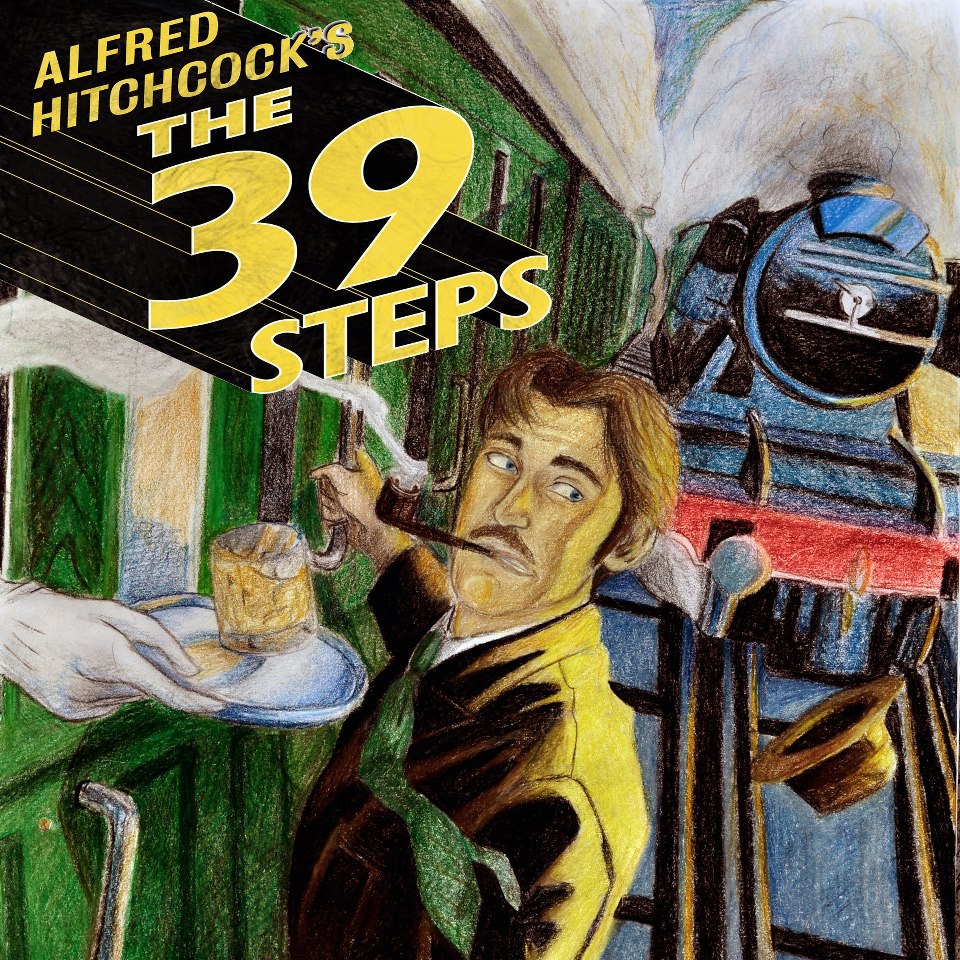
148349_10151198313746567_1557097707_nI am really thrilled to introduce this week, my guest blogger, Ian McDonald. Besides being my better half, he is also a very talented actor. Ian is currently in rehearsals for The 39 Steps which opens on Saturday, February 16th.  This week he shares his experience:

“I always wanted to be an explorer, but – it seemed I was doomed to be nothing more than a very silly person”  – Michael Palin

When I heard that The 39 Steps was being produced by The Parkside Players, I was pretty sure I’d be auditioning for it.  I only say pretty sure because I was fooling myself into thinking I wouldn’t audition for it.  And when I did decide to audition for it, I was still fooling myself into auditioning for the role of the single character Hannay, as deep down I knew I should be auditioning for the role of one of the clowns.

I was built for the role of the clown.  From the late night viewings of Monty Python’s Flying Circus on public television back in the late 70’s, to the memorization of, and subsequent repetition of, just about every piece Python and Kids In The Hall I could get my college-aged hands on in the mid 90’s, it was obvious I was infected with the disease known as “sketch comedy.”  Late one night in 1995, the disease took full root and over caesar salads and carafes of orange juice at Denny’s Joe Koyon, Michael McVeigh, Chris Gladis, and I went all out and invented our own Sketch Comedy troupe.  We were called “It’s Just A Phase” and were on the razor edge of comedic genius – we were edgy, sometimes offensive, often introspective, and always hysterical – at least to each other.  You see this was long before the age of YouTube, portable digital video cameras, and your new fangled interwebs.  We ate and laughed and wrote and laughed and ultimately never shot a single frame of the comic gold we had been mining.  And we really didn’t mind. We were making each other laugh and that was what was really important at the time.  Eventually, we all went our separate ways – staying connected over the years in varying degrees through social media and sometimes visits to the far-away lands to which we had all spread out, and somewhere – possibly in McVeigh’s footlocker, is a black and white marble composition book filled with what the outside observer would no doubt think were the ravings of a madman.  So there it ends – the illustrious and meteoric rise and fall of my multiple character comedic disorder – or so I thought until I was offered the role of the clown.

Malini has often commented in the past on my seemingly schizophrenic ability to be jump from self to character in a matter of seconds when we’ve done shows together.  These days, Malini never knows who is walking in the door after a rehearsal. Could it be the ebullient supershowman Compere?  Is a cockney thug ala Jason Statham’s Turkish sitting in the living room playing on the Playstation? Did Ian just walk through the room in a kilt whistling Scotland the Brave?  And did he just call Malini “Meine schatze” in a German accent? The answer these days is yes to all of the above.  This masterpiece of Hitchcockian comedy has finally allowed me to “get my sketch on,” as it were, playing fifteen different characters with some of them actually having conversations with themselves.  It’s wonderfully frenetic, incredibly freeing, and hysterically funny – at least to me.  And while I always hope others can enjoy my comedy I’ve come to realize that there’s nothing wrong with making yourself laugh.

“He who laughs most, learns best.” – John Cleese

_______________________________________________________________________

The 39 Steps

A Comedy
by Patrick Barlow
adapted from the 1915 novel by John Buchan and the 1935 film by Alfred Hitchcock

Directed by
Susan Young

The 39 Steps is a raucous comedy based on the Hitchcock movie, a man with a boring life and no passion meets a mysterious woman who claims to be a spy. When she is murdered in his apartment, he finds himself running across Britain from the police and an organization of enemy spies, all the while searching for an answer to a question of national importance: What are “The 39 Steps”? A cast of 4 recreate the film playing over 150 characters in a fast-paced whodunit certain to keep you guessing….what madcap stunt the cast will pull next!

Performances
Fridays, February 22 & March 1 at 8:00 pm;
Saturdays, February 16, 23 & march 2 at 8:00 p.m.;
Sundays, February 17 & 24 at 2:00 pm.

Feb 16, 17, 22, 23, 24, March 1 and 2, 2013

Admission: $14 / $12 for Seniors

CAST
RICHARD HANNAY.........................................KC Scwabb
ANNABELLA SCHMIDT/PAMELA/MARGARET.................Monica Barczak
CLOWN 1.............................................Johnny Young
CLOWN 2.............................................Ian McDonald